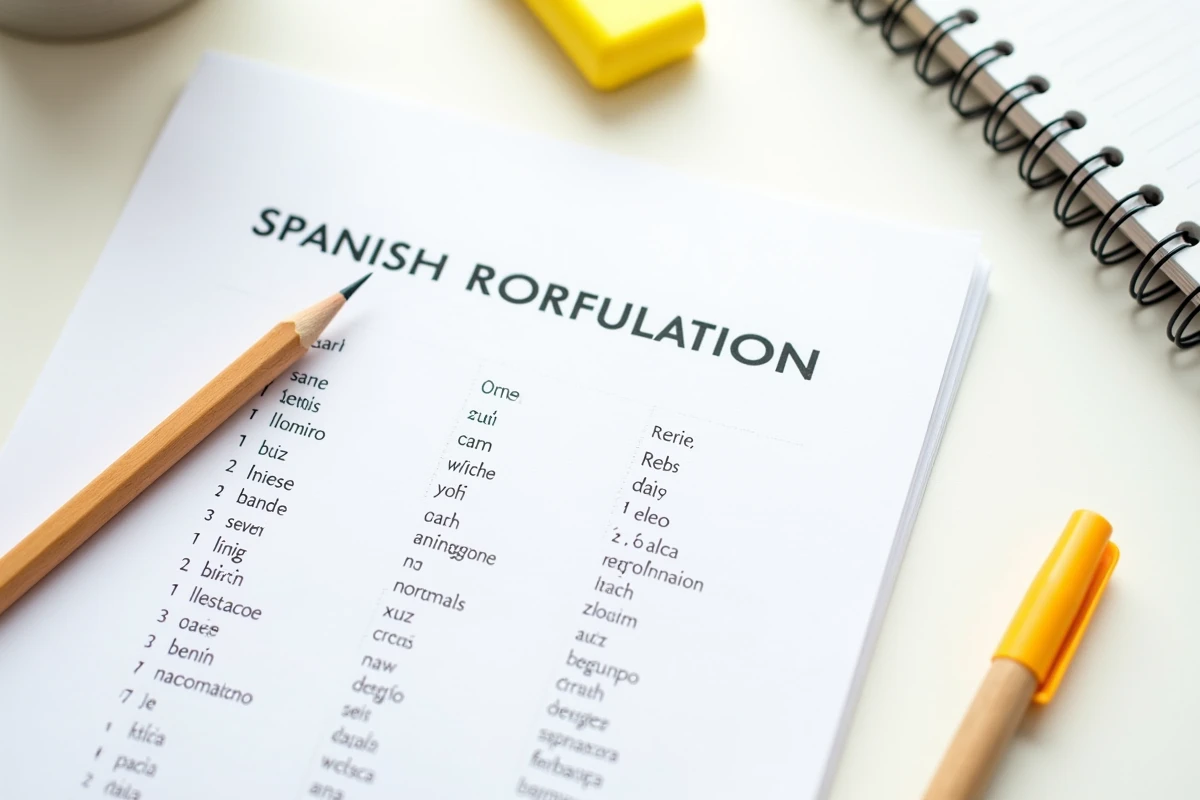
An Spanish conjugation table groups, on a single page, the endings of verbs classified by group (-AR, -ER, -IR) and by tense. This synthetic format allows for a quick visual overview of regularities and exceptions, where a linear list overwhelms the learner with verb forms without visual reference.
Regular endings by group: the foundation to master above all
Three groups structure Spanish conjugation, and each follows a predictable pattern of endings in the present indicative. -AR verbs (hablar, comprar, escuchar) take the endings -o, -as, -a, -amos, -áis, -an. -ER verbs (comer, vender, leer) follow -o, -es, -e, -emos, -éis, -en. -IR verbs (vivir, escribir, recibir) adopt -o, -es, -e, -imos, -ís, -en.
The trap lies in the similarity between -ER and -IR: only the first and second person plural differ (comemos/coméis versus vivimos/vivís). A well-designed Spanish conjugation table to print places these two groups side by side so that the distinction is clear.
Memorizing the regular endings covers the majority of common verbs. Among the most frequent verbs (ser, estar, tener, hacer, ir, poder, decir, poner, salir, venir), most exhibit irregularities, but they often concentrate on the first person singular or on a stem change. Having integrated the regular norm allows for instant recognition of deviations.

Irregular Spanish verbs: categorizing exceptions by type of modification
Listing irregulars one by one would be counterproductive. An effective table groups them by type of modification, significantly reducing the memorization effort.
Irregularities in the first person singular
Several of the most commonly used verbs change their form only in the first person present. Poner becomes pongo, hacer becomes hago, salir becomes salgo, tener becomes tengo, venir becomes vengo, decir becomes digo, traer becomes traigo. The rest of their present conjugation follows the regular pattern of their group.
Diphthongs and vowel weakening
Diphthong verbs change their root vowel under the stressed accent. Pensar becomes pienso (e → ie), volver becomes vuelvo (o → ue), dormir becomes duermo (o → ue). This modification affects all persons except nosotros and vosotros, which retain the original root.
Vowel weakening verbs, like pedir (e → i) or seguir (e → i), follow a similar but distinct logic: the vowel does not double, it simply changes in sound. On a printed table, a color code differentiates diphthong and weakening to avoid confusion between these two phenomena.
The unclassifiable: ser, ir, haber
Ser, ir, and haber escape any category. In the simple past, ser and ir share the same forms (fui, fuiste, fue, fuimos, fuisteis, fueron), which destabilizes learners. Haber functions both as an auxiliary for compound tenses (he, has, ha, hemos, habéis, han + past participle) and as an impersonal verb (hay). A good table isolates these three verbs in a separate box rather than mixing them with other irregulars.
Compound tenses and past participles: the auxiliary + participle mechanism
Spanish compound tenses rely on a simple structure: the conjugated auxiliary haber followed by the past participle, with nothing in between. This rule has no exceptions, unlike French where pronouns can interject.
For regular verbs, the participle is formed by adding -ado to the root of -AR verbs (hablado, cantado) and -ido to the root of -ER/-IR verbs (comido, vivido). The most common irregular participles deserve a dedicated line in the table:
- Escribir gives escrito, hacer gives hecho, decir gives dicho, three forms that stray completely from the root
- Volver gives vuelto, poner gives puesto, ver gives visto, with -to endings that can be confusing at first
- Morir gives muerto, cubrir gives cubierto, satisfacer gives satisfecho, less common forms but regularly present in exams
Grouping these participles on the same table as the compound tenses avoids juggling multiple documents during revision.
Organizing a table by CEFR level to target useful tenses
Some recent resources organize tenses according to the levels of the Common European Framework of Reference (CEFR), an approach that avoids overwhelming a beginner with the imperfect subjunctive when they have not yet mastered the present.
- At level A1-A2, the present indicative, the passé composé, and the near future (ir + a + infinitive) are sufficient for most communication situations
- At level B1-B2, the simple past, the imperfect, the simple future, and the present subjunctive become necessary to nuance discourse
- At level C1, the imperfect subjunctive, the conditional perfect, and the pluperfect subjunctive complete the palette for argumentation and hypotheses
A table structured by CEFR level makes progress visible: each step taken translates into an additional column or row to integrate, without questioning what has already been learned.
Paper or screen support: how format affects memorization
The tables available for download in PDF come in standard A4 format or large wall poster format. The choice of support is not trivial. A table permanently displayed above the desk or on the bedroom wall works through passive exposure: the gaze rests on it without conscious effort, and the endings eventually become visually anchored.
Paper printing encourages repeated and spontaneous consultation, whereas a digital file requires opening a device, navigating to the right folder, and then zooming in. Some educational resource creators use color codes by verb group and by type of irregularity, with readability optimized for distance, making the poster format particularly suitable for classroom use.
The digital format retains an advantage for quickly searching for a specific form, but systematic revision gains regularity with a physical support accessible without a screen. Combining both (poster on the wall, PDF on phone) covers both modes of revision without opposing them.
The most useful conjugation table is the one that is consulted regularly, not the one that contains the most tenses. Start with a document focused on your CEFR level, display it in a high-traffic area, and then replace it with a more comprehensive version as forms stabilize: this step-by-step progression limits discouragement in the face of the dozens of Spanish verb forms.