A freshly painted living room that gives you a headache after two hours, we’ve all experienced that. The problem doesn’t come from the chosen color, but from what the paint releases into the air once applied. Enhancing your interior without considering what you’re breathing is like focusing on the packaging while neglecting the content.
The following suggestions stem from concrete constraints (air quality, actual use of rooms, limited budget) to achieve an interior that works well on a daily basis.
Indoor air quality and material choices: what really changes the decor
When renovating a room, the common reflex is to first choose the color, then the substrate. We should do the opposite. ADEME and the Quality Construction Agency warn about the risks associated with VOCs and formaldehyde present in certain coatings, paints, and furniture. These compounds can diffuse for weeks after installation.
The A+ label on paint cans is not always sufficient. Opt for bio-based paints, and check that new furniture carries a certification indicating low emissions. For flooring, a naturally oiled parquet emits less than a low-end laminate covered with synthetic resin.
Ventilation plays a direct role in the outcome: a clogged or undersized ventilation system traps the pollutants released by your new materials. Before any decoration project, checking the state of the ventilation prevents degrading the air while trying to beautify the space. Feedback varies on this point depending on the type of installation, but cleaning the vents and ducts remains a minimum before starting.
By trying to discover the home section on Infos du Jour, you can find useful references for balancing aesthetics and technical constraints when renovating.

Flexible spaces and dual-purpose rooms: designing for real life
Interior architects have noticed a growing demand for reversible and modular spaces in recent years. Remote work, children in shared custody, home workouts: the uses change from day to day in the same home.
Starting with fixed furniture to organize a room locks in a single use. Comfort increases with elements that move or fold away.
- A removable partition (sliding panel, wheeled screen) allows you to separate a workspace from the living room during the day, then regain the open volume in the evening.
- A wall-mounted drop-leaf desk frees up floor space when not in use, without sacrificing work ergonomics.
- Low furniture on wheels can serve alternately as storage, extra seating, or a visual separator depending on the current configuration.
The idea is not to turn every room into a Swiss Army knife, but to identify the room or rooms whose use genuinely varies throughout the week. A living room that also serves as a gym two mornings a week doesn’t need an immovable coffee table in the center.
Natural light and home lighting: two often underutilized levers
People often think about changing furniture or wall colors when a room looks dull. However, light is the primary factor in ambiance. An off-white wall in a north-facing room will not have the same effect as in a south-facing room, and no light fixture will completely correct this.
Maximize natural light before choosing colors
Clearing windows remains the first action. Thick curtains or a tall piece of furniture placed in front of a light source can sometimes block half of the incoming light. Repositioning just one piece of furniture can radically change the perception of a space.
Mirrors placed opposite a window are not just a magazine cliché. They actually work to reflect light towards the back of a long room. Opt for a large format rather than several small ones, which scatter the reflection without real benefit.
Layer artificial lighting sources
A single ceiling light produces flat lighting that flattens volumes. A more vibrant atmosphere can be achieved by combining three types of sources: general diffuse lighting (pendant or dimmable ceiling light), task or reading spots (desk lamp, adjustable wall sconce), and accent lighting (subtle string lights, LED strip behind a piece of furniture).
The choice of color temperature is as important as the intensity. In living spaces, a warm light (around 2,700 K) promotes relaxation. For an office or kitchen, a neutral temperature around 4,000 K helps maintain focus without straining the eyes.
Psychological well-being and interior decoration: beyond style
The rising trend in interior design directly addresses stress regulation. We talk about screen-free zones, corners dedicated to reading or meditation, and materials with a soothing touch (raw linen, untreated wood, terracotta). This is not a passing fad: mainstream brands are now incorporating these codes into their ranges.
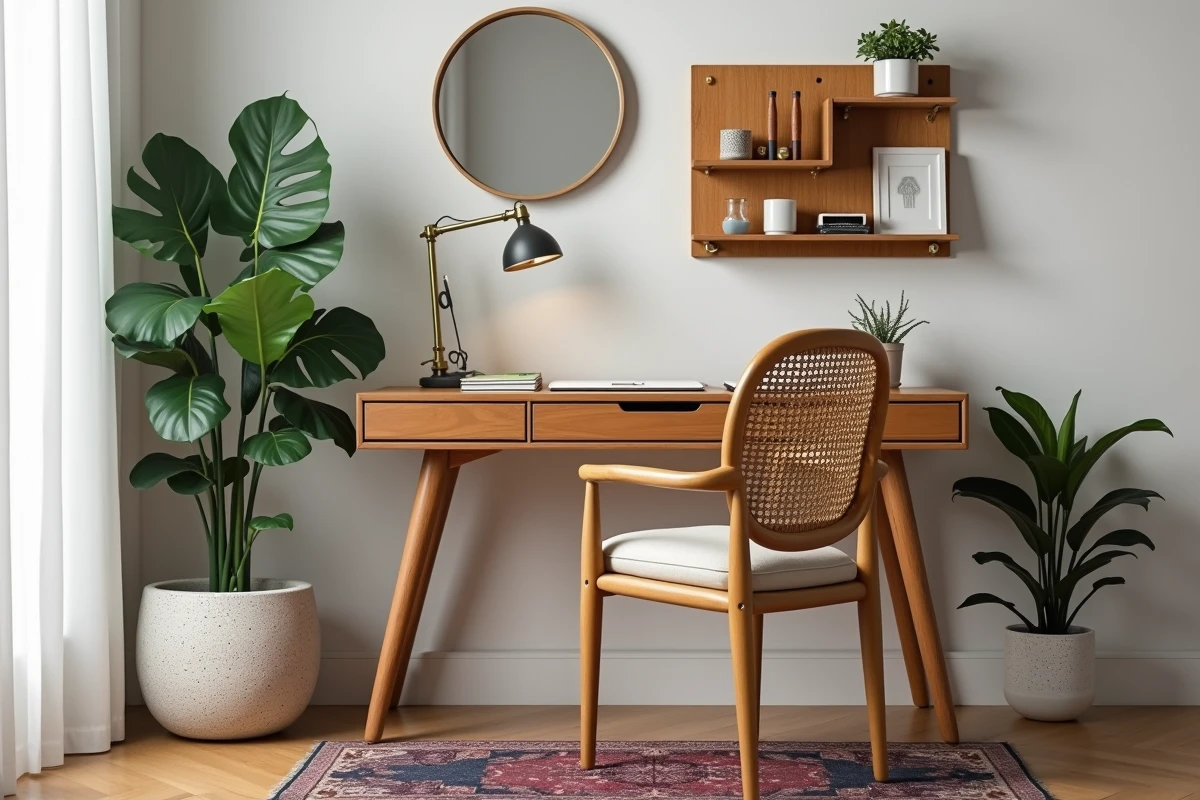
In practical terms, you can define a micro-space of calm even in a small apartment. An armchair facing the wall (and not facing a screen), a large plant creating a visual separation, a thick rug marking the area on the floor: three elements are enough to signal to the brain that you’re changing gears.
Colors also play their part. Saturated hues stimulate, while muted tones (sage green, light terracotta, blue-gray) calm. You don’t have to repaint the entire room: a wall section or the inside of a niche is enough to anchor the ambiance without engaging in major renovations.
Improving your home, in essence, is about balancing what is visible and what is felt. An interior that breathes well, adapts to uses, and incorporates calm zones ages better than any purely decorative trend.