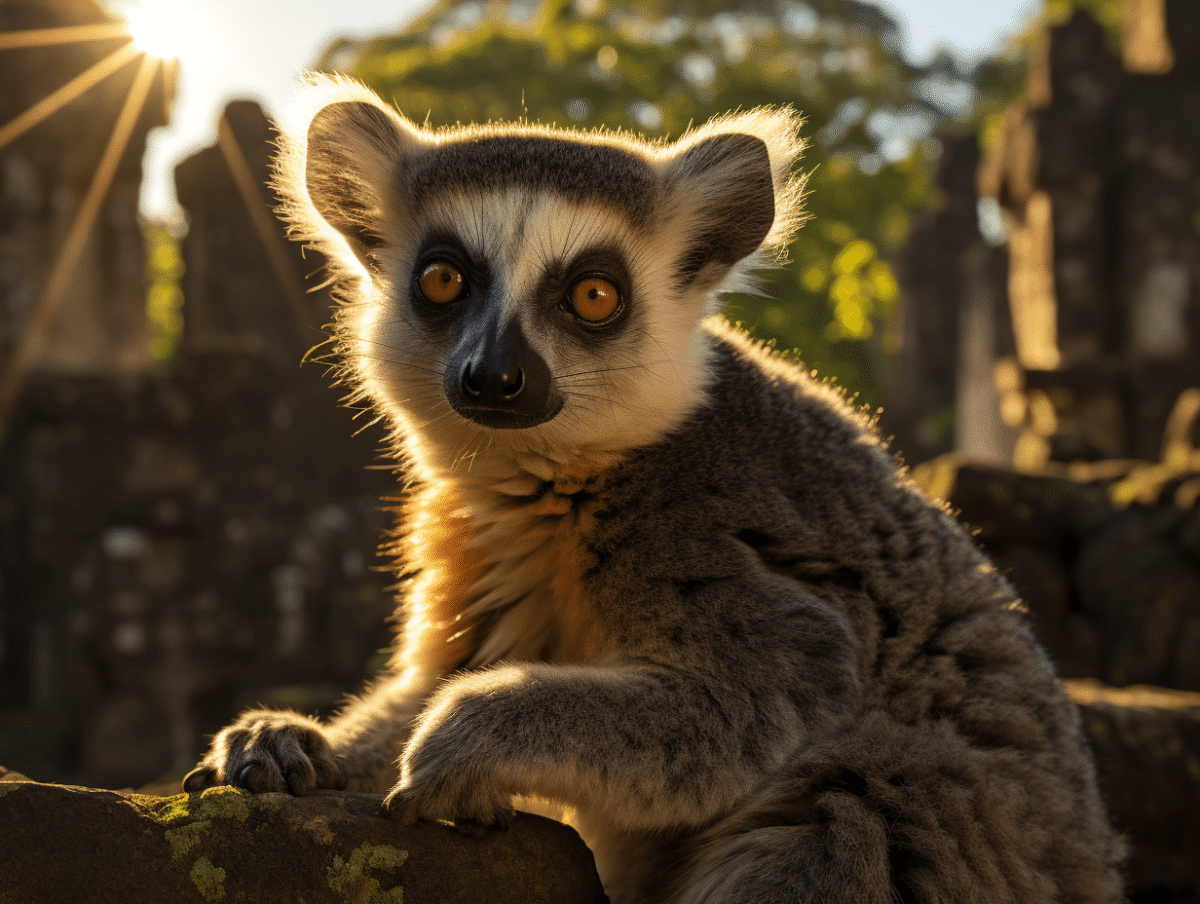
For millennia, lemurs have captivated human imagination, shrouded in a veil of mystery and superstition. These nocturnal creatures, with their bright eyes and ghostly gait, are endemic to Madagascar, an island rich in myths and legends. Local populations, steeped in ancestral beliefs, see these animals as spirits of the forest, messengers between the world of the living and that of the ancestors. Traditional interpretations of their presence and behavior reveal a deep, spiritual, and respectful relationship between humans and the natural world.
Lemurs in Ancestral Culture: Myths and Realities
At the heart of Madagascar, the island where lemurs evolved independently from other primates, these beings carry a powerful mythological aura. Malagasy ancestral culture, rich in beliefs and stories, grants the lemur a status as a mediator between the living and the ancestors. The symbol of the lemur, rooted in local mythology, is that of a guardian of the secrets of the forest, often regarded as a messenger from the beyond.
Malagasy cosmogony, this belief system about the origin of the world, assigns lemurs an essential role. These creatures are perceived as embodiments of ancestral spirits, watching over their descendants and acting as intercessors. The animal is thus surrounded by respectful reverence, and its presence is often accompanied by rites and taboos aimed at honoring its spiritual connection with the world of spirits.
In Malagasy society, lemur myths traverse the ages, testifying to the reality of a harmonious coexistence between man and animal. These stories are not mere fables but fundamental elements of identity and collective wisdom. The reality of lemurs is thus inseparable from their mythical representation, with each observation or encounter likely to reinforce or update traditional beliefs.
Despite modernization, lemur realities persist, adapting while preserving their essence within Malagasy culture. The survival of these unique species represents more than an ecological issue; it is also the maintenance of an intangible heritage, a wisdom, and a worldview that humanity cannot afford to neglect. The conservation of lemurs, beyond the biological imperative, is a safeguard of collective memory and a sacred bond between man and nature.

Lemurs and Contemporary Spirituality: Heritage and Renewal
In the realm of contemporary spirituality, the legacy of lemurs continues and amplifies, nourishing both new and ancient practices. The Malagasy spiritual tradition, passed down through generations, is now revisited, integrating elements of modern esotericism. These practices, while rooted in a traditional context, open up to global interpretations and are enriched by a spiritual renewal that transcends the borders of Madagascar.
Lemurian quartz, a stone with fine and subtle striations, has become a symbol of this renewed connection. Used in meditation rituals and energy healing, this crystal is said to be imbued with the knowledge of the legendary civilization of Lemuria. This myth of a mother civilization, supposedly predating Atlantis and associated with profound wisdom, fuels the collective imagination and grants lemurs an enhanced mystical aura.
Within this vast tapestry of beliefs, the figure of the lemur transforms into a symbol of connection with a mythologized past, a source of lost knowledge. The legend of Lemuria, although lacking scientific foundation, embraces the concept of an original land of harmony and knowledge, where lemurs, as a species, hold a special place, conveying an image of purity and connection with the divine.
The spiritual dimension of the lemur enriches and evolves in the contemporary world. Ancestral myths intertwine with modern aspirations for meaning and connection with the cosmos. This fusion of traditional wisdom and new forms of spirituality confirms the role of the lemur as a bridge between worlds, between history and the present, between nature and man.